




What Is a Round Brilliant Diamond?
A round brilliant is the classic circular diamond, a perfectly round outline cut with 57 or 58 facets arranged to return the maximum amount of light to the eye. It's the most popular diamond shape and the most optically optimized: its faceting is engineered, down to the angles, to produce as much brilliance and fire as a diamond can. It's also the only shape the grading labs give a full overall cut grade, which is why cut quality matters more here than on any other shape.
That paragraph is the whole answer. Everything below is the detail behind it: how the 57 or 58 facets are laid out and why that geometry maximizes light, what brilliance and fire actually mean, why round is the one shape with a full cut grade, why rounds cost more per carat than other shapes, and how a round brilliant works as a Lab Grown Diamond.
Round Brilliant at a Glance
| Attribute | Detail |
| Outline | A true circle, viewed face up. Symmetrical from every angle. |
| Facets | 57, or 58 if the stone has a small culet facet at the bottom point. The layout is standardized. |
| Engineered for | Maximum brilliance (white light returned to the eye) and fire (white light split into flashes of color). |
| Cut grade | The only shape the labs give a full overall cut grade. GIA runs Excellent to Poor; the trade calls the top tier "Ideal." |
| Popularity | The most popular diamond shape by a wide margin, and the most studied. |
| Per carat | The highest price per carat of any shape, because more rough is lost in cutting and demand is highest (Source: StoneAlgo, 2026). |
| On a report | Listed as "Round Brilliant." Read the cut grade and measurements, and confirm the report number on the lab's own site. |
The 57 or 58-Facet Architecture
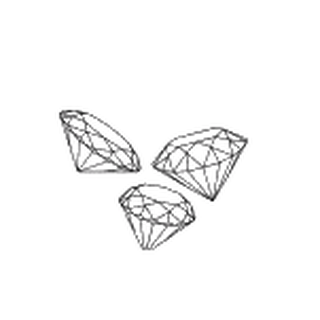
A modern round brilliant carries 57 facets, or 58 if the cutter leaves a tiny flat facet called a culet at the very bottom point. That count isn't arbitrary, and the facets aren't scattered at random. They sit in a fixed, symmetrical pattern that has been refined over a century to do one job: catch light, bounce it around inside the stone, and send it back up through the top.
Here is how the 57 break down, top to bottom:
The crown (33 facets). The top half of the stone. It holds the large flat table in the center, eight kite-shaped bezel facets around it, eight star facets, and sixteen upper girdle facets. This is the light's way in and, mostly, its way back out.
The pavilion (24 facets). The pointed bottom half. Eight main pavilion facets and sixteen lower girdle facets angle the light back up toward your eye. Add a culet facet here and the total becomes 58; leave the point sharp and it stays 57.
The girdle. The thin band around the widest part where crown meets pavilion. It sets the outline and is where a stone is held in its setting.
The reason this works comes down to angles. When the pavilion facets are cut to the right steepness, light entering through the crown hits the back facets and reflects internally instead of leaking out the bottom, then exits back through the top where you see it. Cut the pavilion too shallow or too deep and light escapes through the base rather than returning to the eye. The modern proportions were calculated by Marcel Tolkowsky in 1919, whose mathematical model for light return in a round diamond became the reference point for what the trade still calls the ideal cut (Marcel Tolkowsky, Diamond Design, 1919). If you want the wider context on how a cut differs from a shape, our guide to diamond cut vs diamond shape sets the terms side by side.
Brilliance, Fire, and Scintillation
People say a round brilliant "sparkles," but that sparkle is really three separate effects, and the round is built to deliver all three better than any other shape. It helps to name them, because a good report and a good jeweler will talk about them precisely.
Brilliance. The white light that reflects back up out of the stone. It's what makes a diamond look bright and full of light rather than dull or glassy. The round's facet geometry is optimized to return as much of this white light as possible.
Fire. The flashes of spectral color, red, blue, orange, that you see when a diamond moves. This happens because the facets split white light into its component colors, the same way a prism does. It's called dispersion.
Scintillation. The pattern of bright and dark flashes as the stone, the light, or your head moves. It's the liveliness, the twinkle. Good contrast between the light and dark areas is part of what makes a round look alive.
The round brilliant is the shape where all three are at their peak, which is exactly why it has stayed the default for over a century. That optical performance is a property of the geometry, so it's identical whether the diamond was grown in a lab or pulled from the ground. The material and the physics are the same.
The Only Shape With a Full Cut Grade
This is the single most important thing to understand about buying a round, and it's the one place a round genuinely differs from every fancy shape. Grading labs assign a full overall cut grade only to the standard round brilliant. Because the round's facet layout is standardized and has been studied exhaustively, a lab can measure how well a given stone is cut against a known ideal and score it. GIA runs that scale from Excellent down to Poor. The trade, following the old AGS Laboratories system, calls the very top tier "Ideal."
Fancy shapes do not get this. An oval, a pear, or a marquise receives grades for polish and symmetry, but no single overall cut grade, because there is no one agreed ideal geometry to grade them against. So for those shapes you have to judge the light performance by eye. For a round, the lab has done a large part of that work for you and printed the answer on the report.
| Round brilliant | Fancy shapes (oval, pear, marquise, etc.) | |
| Overall cut grade | Yes, a full grade (for example Excellent, or "Ideal" in the trade) | No overall cut grade from the labs |
| Polish and symmetry | Graded | Graded (but not the same as an overall cut grade) |
| How to judge light | Start with the cut grade, then confirm by eye | Judge by eye and by measurements, no shortcut grade |
The practical takeaway: on a round, cut is the one of the 4Cs to prioritize. A stone can have top color and clarity and still look flat and lifeless if it's cut poorly, because a bad cut leaks light out the bottom instead of returning it to your eye. A well-cut round in a lower color grade will almost always outshine a poorly cut round in a higher one. Buy the cut first.
Why Rounds Cost More Per Carat
Compare a round to an oval or an emerald cut of the same carat weight and color, and the round almost always carries a higher price per carat. There are two straightforward reasons, and neither has anything to do with resale.
The first is yield. A round brilliant is one of the least efficient shapes to cut. Turning a rough crystal into that precise circular outline with 57 correctly angled facets means grinding away a large share of the original weight. A round often keeps only around 40 percent of the rough crystal, where an elongated or step-cut shape can retain considerably more. More of the raw material ends up as dust, so more raw material has to go into every finished carat.
The second is demand. The round is the most requested shape by a wide margin, and steady demand supports a firmer price. Put lower yield together with the highest demand and rounds land at the top of the per-carat range across shapes (Source: StoneAlgo, 2026).
One thing to be clear about: none of this is an investment argument. A diamond is a love piece, not a financial asset, and the per-carat premium simply reflects what it takes to make the shape, not any promise about future value. If you want the same face-up size for less outlay, an elongated shape reads larger for its weight, which is the whole point of our guide to which diamond shape looks biggest. If you want the round's optical performance, you pay for the yield it costs to make it.
The Round Brilliant as a Lab Grown Diamond
A Lab Grown Diamond is a real diamond. It is the same carbon crystal as a mined diamond, with identical hardness (Mohs 10), the same optical properties, and the same brilliance and fire when it's cut to the same proportions. A round brilliant grown in a lab performs exactly like a round brilliant pulled from the ground, because the cut, not the origin, is what controls how it handles light. The round collection we sell is entirely round cut Lab Grown Diamonds.
There is one grading difference worth knowing, and it's about the report rather than the stone. IGI and GCAL still issue full 4C-style reports for Lab Grown Diamonds, including the overall cut grade that makes a round easy to shop. GIA changed its approach: since October 1, 2025 it has graded Lab Grown Diamonds on descriptive Premium and Standard tiers rather than the traditional 4C scale (Source: GIA, 2025-10-01). For a round in particular, where the cut grade is the headline number, it's worth checking which lab issued the report so you know whether you're getting a full cut grade or a descriptive tier.
How to Read the Report
A round brilliant is the easiest shape to shop from a report, because the report tells you most of what you need. Here's the order to read it in.
Confirm the report itself
Find the grading report and type the report number into the issuing lab's own website to confirm it matches the stone in front of you. For a Lab Grown Diamond, IGI and GCAL still issue full 4C-style reports, while GIA has graded Lab Grown Diamonds on Premium and Standard descriptive tiers since October 1, 2025 (Source: GIA, 2025-10-01).
Check the laser inscription on the girdle, including the "LG" marking that identifies a Lab Grown Diamond.
Read the numbers that drive the look
Start with the cut grade. On a round this is the single most important line for how the stone will sparkle. Aim for the top tier your budget allows before you trade down on color or clarity.
Read the measurements for the diameter and depth in millimeters. A round should be close to circular, so the two diameter figures should be nearly equal.
Scan the polish and symmetry grades, which describe the finish and how precisely the facets line up.
For a full walkthrough of every line on the certificate, see our guide to how to read a diamond grading report. And if you're still deciding between shapes, the complete diamond shapes guide sets the round next to every other common outline.
Who a Round Brilliant Suits
A round brilliant suits someone who wants maximum sparkle and doesn't want to think too hard about whether the cut is right, because the labs grade it for you. It's the safe, classic, timeless choice, and there's nothing wrong with wanting the shape that has been the standard for a hundred years. It works in almost any setting, from a plain solitaire to a halo, and it flatters nearly every hand because its symmetry is so forgiving. If you want a stone that reads as unmistakably a diamond and performs at the top of what a diamond can do optically, this is it.
The trade-offs are worth naming plainly. A round faces up smaller than an elongated shape of the same carat weight, so you pay for weight you partly can't see from the top. And it's the most common shape, so it won't stand apart the way a fancy cut does. If either of those matters more to you than peak sparkle, an elongated cut is worth a look. If they don't, the round earns its popularity honestly.
Where Stienhardt Fits
Stienhardt is a New York City jeweler that sources Lab Grown Diamonds and hand-sets and finishes them in NYC, selling direct to you. For a round brilliant, that direct model means we can hold every stone to the standard the shape deserves: because the round is the one cut the labs grade fully, we point you straight at the cut grade and the independent report rather than asking you to take the shape on faith. We own and inspect every stone we sell and hand you its report, rather than drop-shipping it sight unseen.
In-person viewings are by appointment. The rule we keep repeating, even about our own work, holds here too: read the graded report behind any round you're considering, ours included, and let the cut grade lead. A name is marketing. The report is fact.
If you would rather judge a stone in person, we show by appointment in New York. Book a viewing.
Browse by Category
Related Posts


Popular Posts


FAQ's
A round brilliant is the classic circular diamond, a perfectly round outline cut with 57 or 58 facets arranged to return the maximum amount of light to the eye. It's the most popular diamond shape and the most optically optimized, engineered down to the angles for maximum brilliance and fire. It's also the only shape the grading labs give a full overall cut grade.
A modern round brilliant has 57 facets, or 58 if the cutter leaves a small flat facet called a culet at the bottom point. They break down into 33 facets on the crown (the top half) and 24 on the pavilion (the pointed bottom half), arranged in a fixed, symmetrical pattern that maximizes light return.
The round is the only shape the labs give a full overall cut grade, and cut is what controls how much a round sparkles. A poorly cut round leaks light out the bottom and looks flat even with top color and clarity, while a well-cut round comes alive. On a round, prioritize cut before you trade down on the other Cs.
Two reasons. Cutting a round wastes more of the rough crystal, often keeping only around 40 percent of it, so more raw material goes into every finished carat. And the round is the most in-demand shape, which supports a firmer price. Together those put rounds at the top of the per-carat range across shapes (Source: StoneAlgo, 2026). This is about the cost of making the shape, not resale or investment.
Yes. A Lab Grown Diamond is the same carbon crystal as a mined diamond, with identical hardness (Mohs 10) and the same optical properties. A round brilliant grown in a lab returns light exactly like a mined one, because the cut controls the sparkle, not the origin. One grading note: IGI and GCAL still issue full 4C-style reports with a cut grade, while GIA has graded Lab Grown Diamonds on Premium and Standard descriptive tiers since October 1, 2025 (Source: GIA, 2025-10-01).
Aim for the top tier your budget allows. On a GIA-style scale that's Excellent; in the trade, following the old AGS system, the top tier is called "Ideal." A top-grade cut is the biggest single driver of how bright and lively a round looks, so it's worth prioritizing over a slightly higher color or clarity grade. Confirm the grade on the issuing lab's own site.