


 Round
Round
 Princess
 Oval
Oval
 Cushion
 Emerald
 Pear
Pear
 Radiant
 Marquise
 Heart
Heart
 Portuguese
 Long Cushion
 Antique Cuts
 Solitaire
 Halo
Halo
 Vintage
 Side Stone
 Three Stone
 Pave
Pave
 Hidden Halo
 White Gold
 Yellow Gold
 Rose Gold
 Platinum
 Best Sellers
 Ready to ship
 Custom Rings
 French Marquise
 Portuguese
 Elongated Hexagon
 Dutch Marquise
 Oval Portuguse
 Old Mine
 Asscher
 Moval
Moval
 Elongated Hexagon
 Dutch Marquise
 French Marquise


What Are Lab-Grown Diamonds?
Lab-grown diamonds are real diamonds created using advanced technology that replicates natural diamond formation — identical in beauty, durability, and brilliance, while offering greater transparency and value.
Educational resource developed by Stienhardt's diamond specialists and aligned with internationally recognized gemological standards.
Diamond Expertise You Can Trust
This educational guide reflects Stienhardt's exclusive focus on lab-grown diamonds. All information is aligned with globally recognized gemological institutions, including the Gemological Institute of America (GIA) and International Gemological Institute (IGI).
- Aligned with GIA & IGI grading standards
- Reviewed by in-house diamond specialists
- Updated to reflect current industry practices
Why Choose Lab-Grown Diamonds?
*Based on GIA grading definitions and published diamond lifecycle assessments.
Key Benefits of Lab-Grown Diamonds
Lab-grown diamonds are chosen for their identical physical properties, transparent pricing, and responsible sourcing — all while meeting the same international gemological standards as mined diamonds.

Chemically & Optically Identical
Lab-grown diamonds share the same chemical composition (pure carbon), crystal structure, and optical performance as natural diamonds. They are graded using the same 4Cs standards by recognized laboratories such as GIA and IGI.

More Accessible Pricing
Because they are created in controlled environments, lab-grown diamonds typically cost 30–50% less than comparable mined diamonds, allowing buyers greater flexibility in size, quality, or setting choice.

Responsible & Transparent Sourcing
Lab-grown diamonds do not require mining and are free from conflict-related concerns. Their controlled production process generally results in a lower environmental footprint compared to traditional diamond extraction.
Information reflects current gemological standards and industry practices. Individual diamond characteristics and pricing may vary.
How Lab-Grown Diamonds Are Made
1. HPHT Method
High Pressure High Temperature (HPHT) replicates Earth's mantle conditions — applying extreme pressure and heat to crystallize pure carbon into diamond form.
2. CVD Method
Chemical Vapor Deposition (CVD) grows diamonds atom-by-atom in a controlled chamber, allowing precise control over clarity and crystal structure.
3. Expert Cutting & Grading
Once grown, diamonds are cut, polished, and graded using the same 4Cs standards applied to natural diamonds.
Are Lab-Grown Diamonds Real?
Yes. Lab-grown diamonds are real diamonds with the same chemical composition, crystal structure, and physical properties as mined diamonds.
According to the Gemological Institute of America (GIA), lab-grown diamonds are optically and physically identical to natural diamonds — the only difference is their origin.
- ✔ Pure carbon crystal structure
- ✔ 10 on the Mohs hardness scale
- ✔ Identical brilliance and fire
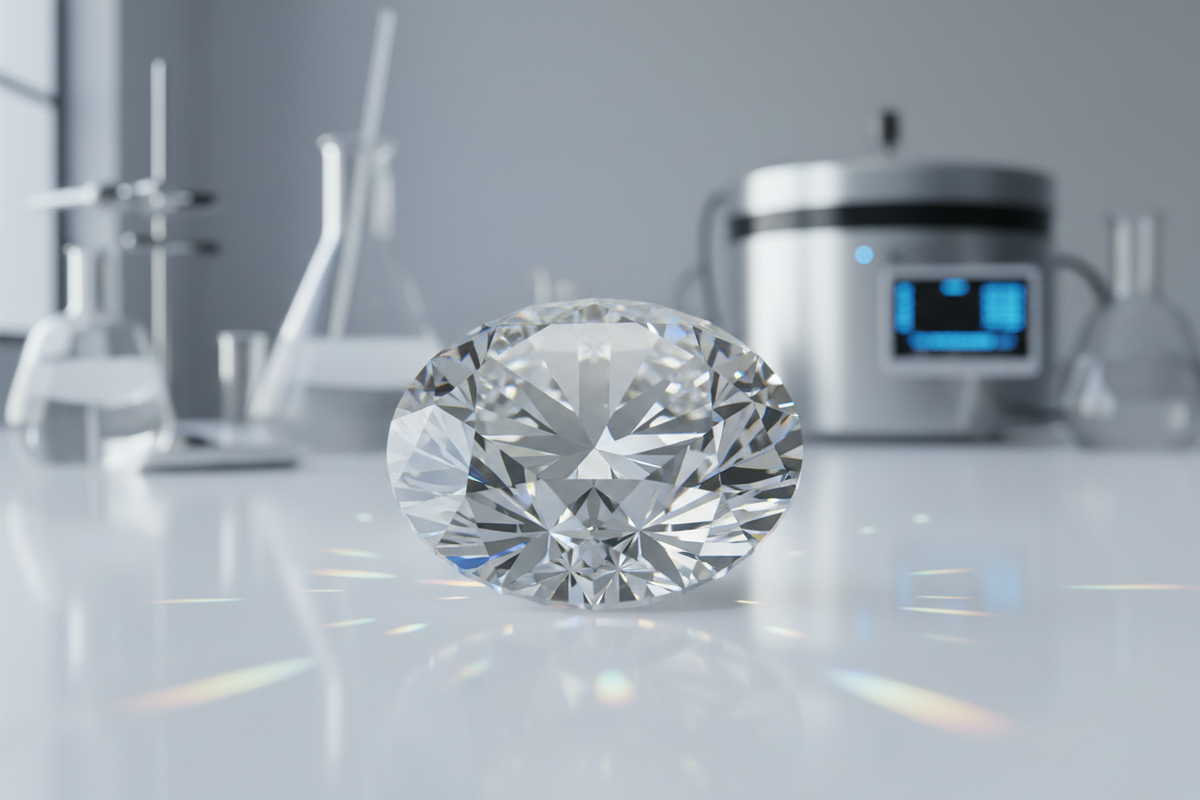

Are Lab-Grown Diamonds Certified?
Yes. Lab-grown diamonds are independently graded and certified by internationally recognized gemological laboratories.
- Gemological Institute of America (GIA)
- International Gemological Institute (IGI)
Lab-Grown vs Natural Diamonds
| Feature | Lab-Grown | Natural |
|---|---|---|
| Composition | Pure Carbon | Pure Carbon |
| Hardness | 10 (Mohs) | 10 (Mohs) |
| Certification | GIA / IGI | GIA / IGI |
| Environmental Impact | Lower | Higher |
| Price | More Accessible | Higher |
| Color & Clarity | Often near-perfect; fewer inclusions | Unique natural variations; rare colors possible |
| Origin & Story | Modern, created in labs | Millions of years old, natural formation |
| Resale Value | Lower | Generally higher |
| Ethical Considerations | Conflict-free by default | Certified options only |
| Variety & Customization | Can produce larger or specialized shapes | Limited by natural availability |
Both are real diamonds — the choice depends on personal values, budget, and preference.
Why Trust Stienhardt's Diamond Expertise?
Stienhardt specializes exclusively in lab-grown diamonds and fine jewelry. Each diamond is independently graded, verified against its certification report, and carefully inspected prior to setting to ensure accuracy, transparency, and quality.
- Easy Financing Options Flexible payment solutions designed for clarity and convenience.
- Lifetime Warranty Ongoing coverage for craftsmanship and manufacturing integrity.
- Hassle-Free Returns Clear return policies to support confident purchasing decisions.
- Free Resizing Professional resizing services for optimal comfort and fit.
- Conflict-Free Diamonds Lab-grown diamonds with verified ethical sourcing.
- Expert Support Dedicated customer service for all your jewelry needs.


FAQ's
Lab-grown diamonds are real diamonds created in controlled laboratory environments using advanced technology that replicates natural diamond formation. They have the same chemical, physical, and optical properties as mined diamonds.
Yes. Lab-grown diamonds are 100% real diamonds. They are made of pure carbon, share the same crystal structure as natural diamonds, and score 10 on the Mohs hardness scale.
Lab-grown diamonds are produced using two methods:
- HPHT (High Pressure High Temperature): Mimics the Earth’s natural diamond-forming conditions.
- CVD (Chemical Vapor Deposition): Grows diamonds layer by layer from carbon-rich gas.
The 4 Cs are the global standard for evaluating diamonds:
- Cut – How well the diamond reflects light
- Color – The absence of color
- Clarity – Internal and external imperfections
- Carat – Diamond weight
Carat weight measures a diamond’s weight, not its size. One carat equals 200 milligrams. Larger carat diamonds are rarer and typically more valuable.
Cut determines a diamond’s brilliance and sparkle. Even with high color and clarity, a poorly cut diamond will appear dull.
Lab-grown diamonds are certified by independent gemological laboratories such as GIA and IGI, which evaluate cut, color, clarity, carat weight, and growth method.
- GIA: Known for strict grading standards and global authority
- IGI: Widely used for lab-grown diamonds and provides detailed grading reports
Both are internationally recognized and trustworthy.
Lab-grown diamonds generally have a lower environmental impact than mined diamonds, as they require no mining and avoid habitat disruption. Environmental impact varies by energy source used in production.
Clean diamond jewelry using warm water, mild soap, and a soft brush. Avoid harsh chemicals and store pieces separately to prevent scratching.
In most cases, fluorescence has little to no visible effect. In rare instances, strong fluorescence may cause a diamond to appear slightly hazy under UV light.